
Santosha: Cultivating Contentment in This Present Moment
Sheri Barnes | FEB 12, 2025
My first exposure to the concept of Santosha was years ago while practicing with a Shiva Rea yoga DVD before yoga was widely available on the internet. I don’t remember a lot about the context, but I do remember learning that “Santosha” translated as “contentment.” Whatever postures or meditation were involved, I recall feeling such a sense of peace when Shiva Rea said the word, “Santosha.”
Santosha, the second Niyama, is the subject of this week’s blog post. While I don’t know if I can say the word in the same peaceful way that Shiva Rea did, I hope to help you understand how practicing Santosha can enhance your life.
I like this quote by Emma Newlyn, “Santosha or ‘contentment’ doesn’t mean idly sitting back and relinquishing the need to do anything. It simply means accepting and appreciating what we have and what we are already, and moving forwards from there.”
“Contentment” and “complacency” are not the same thing. Practicing Santosha doesn’t mean that we are called to live without goals or ambition. Those are still good things. They help us to have something to work towards and to look forward to. This is a form of anticipatory joy, where we have a sense of excitement about something that is to come—in this case, something that we create or accomplish.
What I believe is prescribed in Santosha is a sense of presence. We are called to be here in this present moment and to acknowledge the good in it. It’s okay to be working toward something more, even toward something different. We just need to make sure we are not losing sight of right now and forgetting that, even if it is not perfect, even if it is terribly hard or painful, it is all we are guaranteed, and it is enough.
I acknowledge that this is not easy. There have been plenty of moments in my life when I definitely have not felt content. Nor do I always appreciate every moment. I was far from content for much of the last five years. Yet I have also grown to realize the importance of actively cultivating a sense of contentment.
How do we do this?
· Practice yoga consistently. If you don’t already have a practice, try this week’s gentle Santosha flow to get you started. Yoga gives us an opportunity to be right where we are. It’s a chance to step away, even for a short time, from the responsibilities and stressors of life while we unite mind and body on the mat and settle into each pose. You can even try repeating the words “Santosha” or “Contentment” as you practice as an anchor to help you stay present.
· Engage in purposeful movement, like cycling, walking, running or swimming. Moving in these rhythmic ways while increasing your heart rate can be a great way to cultivate presence and contentment in the moment. On the bike I find that my senses are highly tuned (watching my mirror for cars, listening for dog toenails on the pavement, feeling the elements), while my mind clears. I can appreciate the warmth of the waning sun on my hip and the wind on my face (although I appreciate it more on my back! 😊). Bonus points for moving through nature.
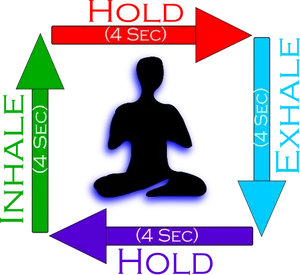
· Meditate regularly. Meditation can come in many different forms. It can be guided or self-led. It can be a seated or walking meditation. You can focus on a mantra or your breath. The main thing is to dedicate some time—even five minutes—daily to consciously be in the present. My morning meditation evolves and undulates over time. I use ambient sound from Insight Timer app. There are also guided meditations, but I just play a soothing sound. I set the timer for five minutes, but I usually end up meditating for 10 minutes or so. Currently, I am using a comfy chair that I recently added to my wellness studio because it feels better on my back and hips than cushions were feeling. I start with Square Breathing (see below), which I find very centering. I follow that with some visualization and repeat a mantra with each inhale and exhale. I include a quick body scan and notice what I feel, taste, hear, smell and see. I finish by setting an intention for the day. There is no right or wrong way. The most freeing advice I have ever received about meditation is that the point is not to clear my mind of all thoughts but to continually return to a calm mind when I notice thoughts taking me for a ride. That is actually the practice.
· Appreciate time with loved ones. Whether it is rocking our grandbaby, petting a furry companion or participating in an activity with someone we love, a huge piece of contentment resides in noticing the gift that such moments are. Doing these things with full presence, rather than scrolling our phone or engaging in other distractions makes these seemingly mundane activities into exercises in gratitude, which greatly contributes to contentment.
· Get into nature. As mentioned above, engaging in purposeful movement through nature can be particularly powerful. Soaking up the natural world in other ways can be, too. It’s not always practical for most of us to feel waves washing over our toes or to bask in the view from a mountain top, walking in a park or on a rail trail or sitting in a green space and really noticing our surroundings can enhance contentment by allowing us to experience awe and wonder at nature’s beauty and power.
· Interact with a spiritual community. For some, a church, synagogue or mosque can inspire contentment. Again, this may often come, at least in part, by a sense of awe at something larger than we are. Being with like-minded others who also appreciate and experience the presence of a higher power can further bolster contentment.
· Develop a regular journaling practice. You can do this in the evening, morning or whenever it fits into your day. It can be a guided journal or free-style writing. You can make it specifically about gratitude or just include appreciative observations in your journal. I have referred to Martin Seligman’s 3 Good Things practice in previous blog posts and used that for years in my journaling. I mostly do it in my head these days, but I sometimes write it in my journal. Whatever your journaling entails, it can be very helpful for acknowledging the many things that foster your sense of contentment.
· Adopt a gratitude practice. This can be in your head, like my version of 3 Good Things, or it could be keeping a Gratitude Jar, with scraps of paper signifying things for which you are grateful, or could consist of writing letters of thanks to people who make a difference for you. The important thing is to consciously acknowledge the big and small things that make a positive difference in your life.
· Find a way to share your story. Blogging is one way that I practice Santosha. It inspires active reflection, while engaging in an activity (writing) that I enjoy and through which I hope to add value for others. I feel a sense of contentment both while writing and once a post is published. Other creative work could serve the same purpose, expressing your feelings through art or music or dance.
I appreciate Arthur Brooks’ concept of happiness, which he explains this way:
"Happiness has three parts:
Enjoyment: This is not the same as pleasure.
Satisfaction: This comes from managing your 'wants' not maximizing your 'haves.'
Meaning: This requires a lot of suffering, pain and sacrifice, or you won't find this meaning. The route to happiness goes through unhappiness and suffering."
Cultivating a sense of Santosha, contentment, incorporates this concept of happiness. When we are present in the moment, we are more likely to enjoy it. When we engage in some of the activities mentioned above, it is satisfying. We feel and are “enough.” Finally, when we choose to create meaning from our suffering, it is much easier to feel contentment in the present moment. We realize that we have achieved growth that we could not have achieved without the struggle.
While Brooks calls it “happiness,” I think contentment shares many of the same characteristics. For me, Santosha connotes a feeling of settledness and surrender to the moment. We are where we are, and we can appreciate the path to getting here.
Emma Newlyn also says, “We have a habit of waiting to ‘be ourselves’ until we’ve accomplished this never-ending to-do list of things that will make us ‘better’. Well, the truth is – you will always be you, and you can either continue to disregard your awesomeness in favour of reaching towards something you think you’re supposed to be, or appreciate it, love it, and be the best you you can be right now. Truly, authentically, unapologetically you. Content with all you are and all you have, because there is no one else who can offer the world what you have to offer.”
I wish you Santosha in the coming week. I’d love to know how you actively cultivate it.
Sheri Barnes | FEB 12, 2025
Share this blog post