
How Ahimsa Supports Resilience
Sheri Barnes | DEC 15, 2024
Today’s blog post begins a series of posts on the Yamas and Niyamas, guidelines for moral discipline that were outlined by the yoga sage Pantanjali around the beginning of the Common Era.
I want to be clear—I am a student of yoga philosophy, not an expert. I think I had heard of the yamas and niyamas prior to my yoga teacher training, but only vaguely and without an understanding of their application in real life. My yoga teacher training allowed me to develop a better understanding of both the purpose and the application of the yamas and niyamas. My goals with this series are to continue to grow in my own understanding, while providing ideas for my readers to ponder and use in ways that provide value in their lives.
We’ll start with the Yamas, which teach us how to treat ourselves and others.
Ahimsa is the first Yama.
Ahimsa translates as “non-violence” or “non-harming.” Of all the Yamas, this is the one with which I was most familiar prior to my yoga teacher training. I have been vegetarian since 1982 and vegan since 2008 because of my own yearning toward non-harming. From the time I was a child, the idea of eating animals hurt my heart, so I figured out a way to become vegetarian when I was 12. I kept that commitment and never looked back, but, when I was in my 30s, I began to feel an inner nudge to find out whether just not eating meat was truly aligned with my core values. After finally becoming brave enough to read and study the milk and egg industries, I realized that it was not, and I became vegan.
Within the vegan community, I became familiar with the concept of Ahimsa, although I am not sure that I knew that it was part of a larger set of yogic guidelines and not simply a standalone value. Ahimsa made sense for me, since one of my core values—in fact, my top core value—is compassion. The best definition I have come across is the intention to “create the most good and cause the least harm” in the world, taught by Zoe Weil. To be clear, I am not perfect at this. I do try very hard to embody compassion and Ahimsa in my life. Whether entirely correct or not, I find that I conflate the two words in my mind and in my actions.
Some consider Ahimsa to be the most important Yama. I tend to agree. Just as compassion is the core value that flows through and energizes all others for me, Ahimsa seems a fitting underpinning of the remaining Yamas.
When we start from a spirit of non-harming, it allows us to make healthier, kinder behavioral decisions in all aspects of our lives, whether those decisions affect ourselves, others or both.
It’s important to realize that Ahimsa extends beyond the physical. Certainly, it includes not physically harming ourselves or others, and it also includes avoiding emotional and spiritual harm.
Ahimsa supports resilience in several ways.
When we use Ahimsa as the foundation for making decisions about how we nourish and nurture our bodies, we are likely to make choices that support our well-being. This includes eating healthful foods and moving our bodies in ways that enhance, rather than harm our health. I’ve had a lesson in this lately as I have been working to heal from a persistent bout of laryngitis. Admittedly, it is hard for me to back away from my planned exercise routine on a given day, and I have a history of pushing through with the bike ride or strength training program I had planned, even when my body probably needs something gentler. This time—I hope because of some personal growth—I recognized that riding my bike in cold wind probably wouldn’t accelerate my recovery from laryngitis, and I have allowed myself to back off and do gentle yoga instead. That has felt nurturing and aligned with the guideline of Ahimsa toward my body.
Ahimsa also applies to self-talk and the thoughts we allow to narrate our days. This is crucial to choosing resilience in the face of life’s frustrations and disappointments. It can take many forms. Even as I was typing this blog post, I caught myself in a harmful thought. I glanced down at my hands on the keyboard and thought, “My hands look 110 years old.” Quickly, I redirected myself to appreciation for my drive to write this blog and to try to help others through my writing, coaching and yoga. I would not have the experience and wisdom to share if I didn’t have some time under my belt—and on my hands. It’s my experience on my parenting journey over the past several years that inspired me to create PenPedalPose out of a desire to help other parents of kids affected by mental health and substance use struggles. So, part of Ahimsa is choosing a kinder thought for ourselves when we start down a path of self-criticism and negativity. Doing so better positions us for growth and for bringing good into the world, rather than wallowing in a miserable hole we have dug for ourselves.
Ahimsa toward our spiritual lives also increases our resilience. This may take different forms for everyone. For me, it involves carving out at least small periods of stillness and spaciousness in my life, even on the busiest of days. That means that I meditate every single morning, and I do my bedtime yoga every single night. I make room for purposeful movement every day because it allows me to clear my head, even if only for 15 minutes or so on a crazy day. These moments nourish my spirit and help me to keep going when life is tough. While it would be easy to cut them out when life feels too full, doing so would be harmful and not in alignment with Ahimsa.
When we practice Ahimsa with ourselves, we feel cared for and nourished and are more likely to choose actions and words that help other humans and non-human animals in our lives feel cared for and nourished by us. That’s really important to me. I want to show up in the world as someone who cares.
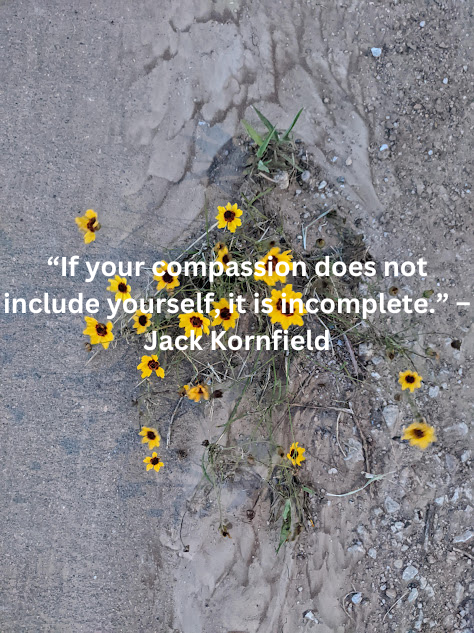
Ahimsa requires balance. It can’t tip so far in the direction of nurturing others that we end up harming ourselves through neglect or self-sacrifice. And we want to be careful that our self-care allows us to be the person we want to be in the world, rather than becoming all-consuming selfishness.
For me, it all comes back to maintaining an intention to create the most good and cause the least harm through my thoughts, words and actions.
How does the concept of Ahimsa sit with you?
What is one way that you can practice Ahimsa toward yourself today?
How can you practice Ahimsa with those around you or with the greater world today?
If you have a different understanding of Ahimsa, please share it with me. As I said, I am still very much a student of yoga philosophy and am open to considering other perspectives that may enhance my grasp of the concepts.
Thank you for reading!
Sheri Barnes | DEC 15, 2024
Share this blog post